
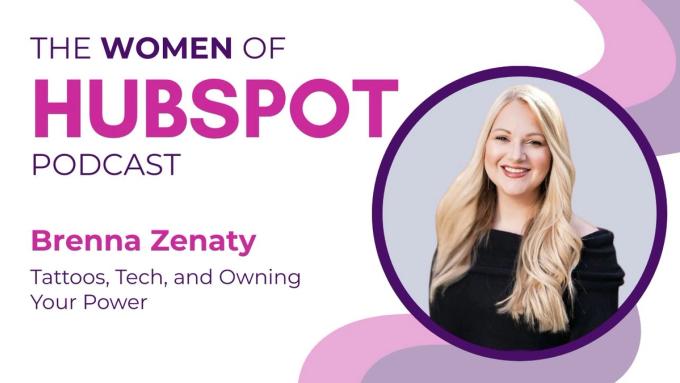
Some career stories appear to be straight lines. Brenna Zenaty’s looks more like a bowl of spaghetti.
Retail floors. Action sports shops. An English major who thought about becoming a vet or a librarian. Then a junior role at a tiny HubSpot partner, a jump into customer success, and finally a seat on the HubSpot Academy team that teaches the ecosystem she once had to learn from scratch.
If you have ever wondered whether your path is “too messy” for tech, leadership, or HubSpot, Brenna’s story is a reminder that nonlinear does not mean lost. It can mean you are quietly building the exact mix of skills you will need later. Let’s walk through how she got here, how she stayed human in the process, and what you can borrow for your own journey.
From Retail Floors to HubSpot Academy
Go back to high school, and you find Brenna in a very competitive environment. Surrounded by Ivy-bound classmates and AP courses, she felt pressure to have her whole career figured out at eighteen, which she now calls “silly for most of us.”
College did not hand her a neat plan either. She switched majors more than once. English. Vet dreams. Librarian dreams. Plenty of ideas, not a lot of focus.
So she worked.
From sixteen on, Brenna spent her time in retail and service roles, especially in action sports retail. After graduation, she left her hometown in New York, moved to Atlanta with her now-husband, and continued working in retail until a new opportunity arose.
That door was a junior marketing role at an early HubSpot partner agency. It was her first “corporate” job, her first tech-adjacent role, and a first for her largely blue-collar family as well. She learned inbound marketing as an inbound marketing specialist. She discovered HubSpot. She found HubSpot Academy as a learner. It was the start of a career chapter she did not even know existed.
From there, she transitioned into customer success at Terminus, an ABM technology company in Atlanta, and then into a brand-new customer education role that combined content, product, and teaching. Eventually, a posting appeared for a role on HubSpot Academy, focused on content for solutions partners.
She saw it and thought, “It feels like a sign” and “a full circle moment.” She went for it. And she got it.
Young Brenna, the kid who just knew she wanted to write, teach, and be creative, would be “pretty stoked” to see where she landed.
Finding Her Voice in a Nonlinear Career
None of this came wrapped in certainty. Brenna did not study learning and development. She did not grow up surrounded by people in tech. She calls herself an extroverted introvert.
Early on, that mix fed a familiar feeling: “Do I really belong here?”
She is careful about words like “imposter syndrome,” especially for women, but she is honest about the pattern. When conversations got technical or strategic, her first instinct was to hold back. She did not always feel expert enough to speak up.
That showed up again when she was deep into her customer education work at her previous company. She managed programs, platforms, and big responsibilities. She aimed hard at the next promotion level. Then, the leadership announced promotions. Her name was not on the list.
That one hurt.
Brenna could have framed it as a simple failure. Instead, after the initial sting faded, she treated it like data. The company was shifting focus. The business was not leaning into the work she wanted to do long-term. That did not make them “bad” and her “wrong.” It just meant that the season might be over.
So she asked a better question: If this chapter were to end, what could the next one be?
Almost on cue, the HubSpot Academy role for partner content appeared. She read it, recognized her own skills in the description, and chose to pivot. In interviews for that job, she felt a kind of grounded confidence she had not always had.
She finally had stories and proof for every question.
That confidence was not accidental. It came from years of building programs, managing tools, shipping content, and learning from her own community.
Building Education Programs from the Ground Up
One of Brenna’s most intense “ops crucibles” happened before she ever stepped into HubSpot. At Terminus she moved from customer success into the company’s very first dedicated customer education role. There was no established team. No internal Academy. No playbook.
She was essentially a one-woman team.
Her job was to implement their first learning management system, launch their first certification program, and create product training for customers. She had to design the strategy while also clicking every button.
So she did what good educators do. She became a great learner.
She joined a Slack community for customer education and support. She read, asked questions, watched what other teams were shipping, and used that community as a sounding board whenever she got stuck. Over and over, she went back to that group to figure things out.
That season taught her three habits she still leans on:
- Use the community as a tool. You do not have to invent everything in a vacuum.
- Ship while you learn. Implementation and experimentation can happen at the same time.
- Let your experience travel with you. The LMS, certification, and training work she did there became the backbone of her confidence when she later applied to HubSpot.
Now at HubSpot Academy, Brenna brings that same builder’s mindset to a much bigger stage. She and fellow senior professor Meg Duffy co-created the HubSpot Implementation for Partners certification, a program that bets on use-case-driven education instead of isolated feature checklists.
Rather than teaching forms “over here” and lists “over there,” they start from realistic customer scenarios and show how tools like forms, landing pages, website pages, and lists fit together to form actual solutions.
It is more creative. It uses more storytelling. And it aligns with the way real consultants and partners operate.
Empowerment, Community, and Saying Yes to Scary Things
Brenna is very clear about one thing. She did not get here alone. She credits agency owner Ann Marsden for taking a chance on an English major with no formal marketing background and opening the door into the HubSpot ecosystem.
She points to women leaders at Terminus who were “building the plane as we were flying” beside her at an early-stage startup. She calls out Sidney Smith, who saw her potential and invited her into that first customer education pilot role.
Inside HubSpot Academy, she talks about colleagues like Meg Duffy and Jorie Monroe, who constantly push her to improve her craft of education while also supporting her as a person. She describes the Director of the Academy, Courtney Sembler, as a leader who always makes time to talk about careers, not just content.
Across all of that, empowerment keeps showing up as something very practical.
For Brenna, empowerment means:
- Listening to women and believing them when they share their experiences.
- Supporting programs like employee resource groups, mentorship, and leadership training.
- Making sure underrepresented people get real chances to sit at the table and lead.
- Saying “yes” to opportunities that trigger fear instead of waiting for perfect readiness.
That last one matters. A lot.
When she was first invited to speak at INBOUND, her gut reaction was simple: “That is not me. Could never be me speaking in front of 700 people.” Public speaking sits high on her personal fear list. She chose to say yes anyway.
She prepped, stepped onto that big stage, delivered, and walked off with a new story about who she could be. The first thing she told her manager afterward was, You know what? I would do that again.
“I'm trying to make More of my career saying yes to things that initially make me uncomfortable.”
~ Brenna Zenaty
She is also now a mentor in HubSpot’s customer success internship program and an active part of Women at HubSpot channels, buddy programs, and coffee chats that connect people across teams. And she knows that empowerment is not just internal work. It is also about challenging the patterns she sees around promotions and opportunities:
“Sometimes it feels harder to ask for the thing that we want than to sit back.”
~ Brenna Zenaty
Her encouragement to women in tech: notice that reflex, then push against it. Have the promotion conversation. Apply for the fellowship. Ask to lead the project. The discomfort of asking often beats the long-term weight of wondering.
Why Brenna’s Story Matters for Your Work
Brenna’s story is not only inspiring. It is practical.
Here is why it matters for you if you are a business owner, HubSpot Super Admin, marketer, or ops leader.
- Nonlinear paths build powerful operators. Retail, service jobs, agency work, customer success, and customer education gave Brenna empathy, communication skills, and systems thinking. Your “random” experience might be the exact toolkit your next role needs.
- Feeling overlooked is information, not a verdict. When promotions passed her by, she did not let that define her worth. She used it as a signal that it might be time to pivot toward work and companies that matched her values and strengths.
- Use case thinking beats tool-only thinking. The way she and the Academy team now design content for partners mirrors what your own teams and clients need. Stop teaching and selling tools in isolation. Start from real use cases and show how HubSpot comes together to solve them.
- Community is a strategic asset. Brenna’s Slack groups, mentors, and internal networks were not nice-to-have extras. They were critical to shipping programs, landing new roles, and maintaining her confidence.
- Empowerment multiplies when you pass it on. She benefited from leaders who took chances on her. Now she mentors, collaborates, and opens doors for the next wave. Your influence works the same way.
If you have ever thought, “I did not study this,” “My background is too different,” or “I am not expert enough to speak up,” Brenna’s journey is a live case study that you can become an expert by doing the work, sharing what you learn, and staying close to the community.
You do not need a perfect plan. You need the courage to take the next honest step.
Reflect & Act
Take a minute with these and write down your answers:
- Where in your current role do you feel “not expert enough,” and what small step could you take this month to learn in public anyway?
- What recent disappointment or missed promotion might be pointing you toward a new chapter rather than proving that you failed?
- Which community, mentor, or peer could you reach out to this week and simply ask, “Who else should I be talking to?”