

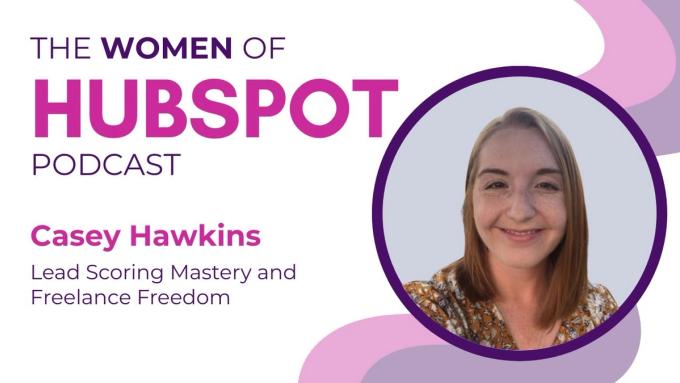
Casey Hawkins did not plan a straight-line career. She built one by saying yes to the next right step, even when it started with something as random as bookkeeping at a local pool construction company.
In this Women of HubSpot episode, I sat down with Casey, a HubSpot and marketing consultant based in Annapolis, Maryland. We talked about how she found her lane, how she learned to own her expertise, and how she helps teams make marketing and sales processes work better inside HubSpot.
Casey shows what happens when you stay grounded, focus on execution, and treat helpfulness like a real strategy. She also tells the truth about burnout, pricing, and why community matters more than most consultants admit.
The moment that changed everything
Casey’s story starts in a place a lot of people recognize. New graduate. First job. Trying to be grateful. Quietly wondering, “Is this it?” She was interning at a pool construction company when the owner told her they were about to fire their bookkeeper and asked her to post the job.
Casey looked at the moment, looked at her workload, and basically raised her hand. She did the bookkeeping for a year and hated it. Not disliked it. Hated it.
Then she did something that still makes me smile. She tweeted, “I hate my job” and a college friend replied, “come work with me.” That was the pivot.
Casey moved into agency life at a HubSpot partner agency and started learning everything she could. She leaned into the idea of being a T-shaped Marketer, knowing a little about a lot, then going deep in the areas that clicked. HubSpot became one of those deep areas.
That one tweet did not just change her job. It changed her direction.
How she leads, builds, and uses HubSpot
Casey does not lead with volume. She leads with value. She will be the first to tell you she is not the loudest person in the room. In agency life, that meant her ideas sometimes got bulldozed, especially when louder voices jumped in first. She learned the hard way that being quiet does not protect your expertise. You have to claim it.
That lesson became even sharper when she went out on her own.
Last summer, she took on too much. She was billing fifty or sixty hours a week, which meant working far more than that. She said yes to an audit for a complex portal, cut corners because she ran out of time, and the client noticed. The delivery call was painful. She walked away from the client because she knew she could not support them the way they deserved.
That moment sounds like a setback, but it is also a boundary forming in real time. And that is a theme with Casey. She pays attention to the signals. She adjusts. She keeps moving.
When it comes to HubSpot, Casey is locked in on lead scoring right now, and for good reason. With the older scoring approach being retired, she sees a real opportunity for teams to rebuild scoring so it reflects real interest and real engagement, not just a static checklist of traits. She loves the shift because it helps teams stop guessing and start paying attention to what people actually do.
She also has a strong point of view on what matters most in any strategy conversation. Execution. She is the person who will bring it down to the ground and say, “Cool idea. Now, which buttons do we push?”
Connect with Casey Hawkinson LinkedIn.
The lesson she wants you to carry forward
Casey kept circling back to empowerment, and I loved how she defined it. To her, empowerment is knowing your strengths, knowing your worth, and feeling steady enough to stand on it. Not with arrogance. With clarity.
She sees this most when newer consultants reach out. They think they need a big company name behind them to be taken seriously. Casey pushes back on that. She believes you do not need to be a company to start.
You need to be a helpful human. And she practices what she preaches.
She takes calls with new consultants. She answers messages. She shares what she charges. She talks about money openly because she remembers how hard it was to price herself when nobody else would say numbers out loud. Her advice is simple and bold: “ask for more money than they think.” Not to be greedy.
To stop undervaluing the work before the client ever gets a chance to.
She also shared something that is sitting heavily on her heart right now. She just got approved to be a foster parent, and it has her thinking about how motherhood, caregiving, and career expectations collide. She wants the world to stop measuring “hard work” in a way that punishes women for doing the invisible labor that keeps families functioning.
And then she brought it home with a definition of success that sounds like wisdom, not hustle. Work-life balance. Enjoying life. Feeling comfortable financially. Still doing meaningful work, but with enough room to take a walk midday, go for a run, and live like a human.